
How to Choose Stainless Steel Buttons for Global Sourcing?

Choosing Stainless Steel Buttons for global sourcing requires more than comparing catalog photographs. A bright surface may hide weak plating, sharp edges, or inconsistent threading. The button must suit the garment, production method, destination market, and care instructions. Small details matter.

Apparel hardware specialist Michael J. Kaye states, “A button is small, but its failure can define the whole garment.” His observation reflects practical factory experience. Buyers should request material specifications, dimensional drawings, finish samples, and recent inspection records. Stainless steel grades deserve careful attention. Grade 304 often supports general apparel use, while Grade 316 may offer stronger resistance in humid or salty environments. However, the correct grade depends on design, exposure, cost, and supplier capability.

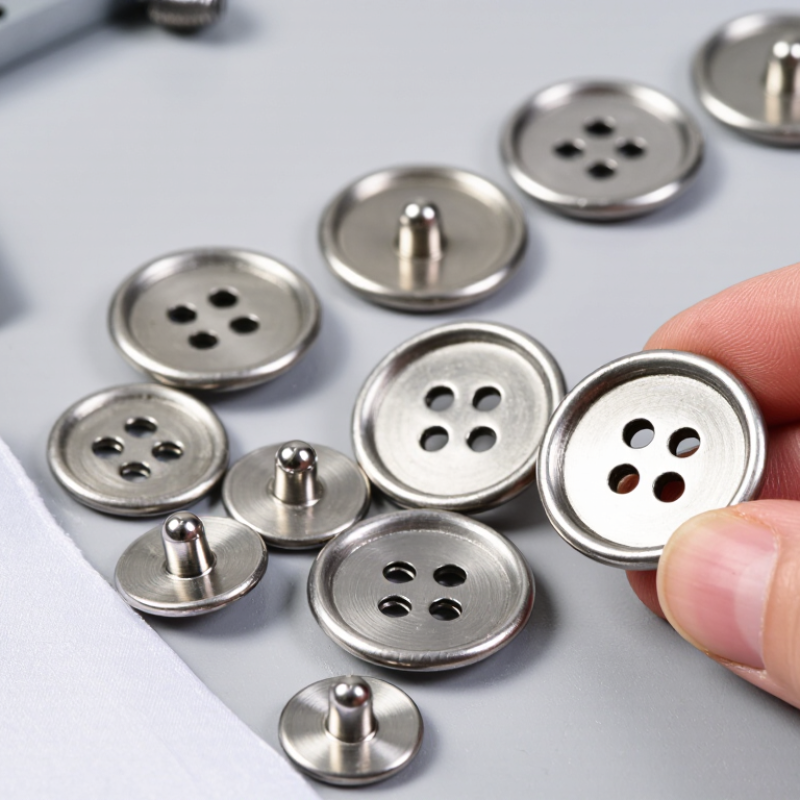
Ask for corrosion testing, pull-off strength results, and nickel-release documentation when relevant. Check the button by hand. Run a fingernail around its rim. Inspect the shank, holes, back, and polishing marks under direct light. A sample can look perfect, yet bulk production may vary. That is the uncomfortable part. Sampling alone is not enough. A written quality limit, approved reference sample, and pre-shipment inspection create better control.

Global sourcing also requires clear communication. Confirm packaging, carton quantities, labeling, lead times, replacement policies, and factory audit records. Do not select the lowest quotation automatically. An inexpensive button can create rework, customer complaints, or damaged brand trust. Stainless Steel Buttons should balance durability, appearance, compliance, and production reliability. The best choice is rarely the most decorative one. It is the one that performs consistently after thousands of garments leave the factory.
How to Choose Stainless Steel Buttons for Global Sourcing?

Define Button Requirements: Size, Shank Type, Load, Finish, and End Use

Choosing stainless steel buttons for global sourcing starts with a precise requirement sheet. Specify diameter, thickness, hole spacing, and shank type before requesting samples. A 15 mm button may suit a lightweight shirt, while a larger shank button needs stronger fabric support. End use changes everything: workwear needs impact resistance, children's clothing needs secure attachment, and outerwear needs better corrosion protection. The International Stainless Steel Forum reported 58.4 million tonnes of global stainless steel production in 2023, showing the scale of available material, but not every grade suits apparel hardware.

Define the expected load with a real test method. ASTM D4846 measures the resistance of fasteners pulled from fabric, helping suppliers compare button attachment strength. Test the complete system, including thread, fabric, washer, and shank. The button alone can pass while the garment fails. That detail is often missed. Record the stainless steel grade, surface treatment, coating thickness, and salt-spray results where relevant. ISO 9227 can support corrosion testing, although its laboratory conditions do not perfectly represent daily wear.

Finish selection should match the garment’s touch, cleaning process, and visual life. Brushed surfaces hide fingerprints better, while mirror finishes reveal tiny scratches under store lighting. Ask for color consistency across production lots. I once treated “silver” as a sufficient finish description; it was not. Require approved samples, dimensional tolerances, pull-test records, and packaging details. Review these documents before bulk production, not after a shipment arrives.

Select 304 or 316 Steel: 18–20% Cr, 8–14% Ni, and 2–3% Mo

Choosing stainless steel buttons begins with chemistry, not appearance. ASTM A240/A240M identifies 304 stainless steel with about 18–20% chromium and 8–10.5% nickel. Molybdenum is normally absent as an intentional addition. For 316 steel, chromium is generally 16–18%, nickel is 10–14%, and molybdenum is 2–3%. The ranges overlap, but they are not interchangeable.

That difference matters. Molybdenum improves resistance to chloride corrosion from seawater, sweat, and humid storage. For coastal uniforms, outdoor garments, or frequent washing, 316 can reduce staining around button holes. For everyday apparel and controlled indoor use, 304 often provides sufficient durability at a lower material cost. The Nickel Institute’s technical guidance links molybdenum-bearing stainless grades with stronger resistance in chloride environments. World Stainless reported approximately 58.4 million tonnes of stainless crude steel production in 2023, showing the scale of this established material sector.

Inspect the button, too. A 304 button with a clean polish may outperform poorly finished 316 hardware. Surface scratches, sharp edges, and trapped moisture can create disappointing results. I have seen buyers approve a bright sample, then overlook salt-spray testing and attachment strength. That is an avoidable gap. Request mill certificates, alloy verification, coating details, and test conditions. Also check whether the supplier calls a product “316” without declaring its molybdenum content. A confident label is not proof.

How to Choose Stainless Steel Buttons for Global Sourcing? - Select 304 or 316 Steel: 18–20% Cr, 8–14% Ni, and 2–3% Mo
Sourcing Dimension 304 Stainless Steel 316 Stainless Steel Practical Selection Guidance
Typical chemical composition by mass Chromium: 18.0–20.0%
Nickel: 8.0–10.5%
Molybdenum: not intentionally added
Chromium: 16.0–18.0%
Nickel: 10.0–14.0%
Molybdenum: 2.0–3.0%
Verify the material test report against the applicable specification. Actual limits can vary by product standard and grade designation.
Corrosion resistance Good resistance in normal indoor, dry, and mildly humid environments. Generally better resistance to chloride-related pitting and crevice corrosion because of molybdenum. Choose 316 for marine exposure, coastal humidity, de-icing salt, perspiration, or frequent contact with chloride-containing substances.
Common button use conditions Shirts, jackets, bags, uniforms, footwear, and general fashion accessories used mainly indoors or in moderate environments. Outdoor apparel, marine or travel products, sportswear, workwear, medical-related accessories, and products exposed to sweat or salt air. Base the choice on the most severe expected exposure, not only on the garment category.
Mechanical and forming characteristics Austenitic, ductile, and suitable for stamping, drawing, machining, and decorative finishing. Austenitic, ductile, and suitable for stamping, drawing, machining, and decorative finishing; generally more costly to process. Confirm the button design, thickness, shank or hole geometry, and forming process with the supplier before mass production.
Magnetic response Normally non-magnetic in the annealed condition; cold working can produce some magnetic response. Normally non-magnetic in the annealed condition; cold working can also produce some magnetic response. A magnet check is only a screening method and cannot confirm the grade. Use chemical analysis or a material certificate for verification.
Surface finishing compatibility Compatible with polishing, brushing, bead blasting, passivation, and many decorative coatings. Compatible with the same major finishes and offers improved corrosion margin in demanding environments. Specify the finish requirement, surface roughness or visual sample, coating system, and cleaning method in the purchase specification.
Relative material cost Usually the lower-cost option because it does not require molybdenum alloying. Usually higher in material cost because of its nickel and molybdenum content. Compare total lifecycle cost, rejection risk, and corrosion performance rather than unit price alone.
Recommended purchasing specification State “304 stainless steel” or the required equivalent standard, plus dimensions, finish, tolerance, and testing requirements. State “316 stainless steel” or the required equivalent standard, plus dimensions, finish, tolerance, and testing requirements. Avoid vague terms such as “stainless look” or “metal button.” Identify the grade and acceptance criteria clearly.
Quality verification before shipment Check dimensions, appearance, attachment strength, surface defects, corrosion condition, and material documentation. Check the same items, with particular attention to chloride exposure testing when the end use is marine, coastal, or high-sweat. Use approved samples, an agreed inspection level, batch traceability, and independent alloy verification when grade identity is critical.
Reference note: Composition ranges shown are commonly specified for wrought 304 and 316 stainless steel products under ASTM A240-type requirements; the exact limits depend on the applicable standard and product form.

Verify EU REACH Nickel Release Below 0.5 μg/cm² per Week

How to Choose Stainless Steel Buttons for Global Sourcing?

For garments sold in the EU, nickel release deserves close attention. Buttons touching skin for prolonged periods should release no more than 0.5 μg/cm² per week under REACH requirements. This measures released nickel, not the total nickel inside the steel. That difference matters.

Ask suppliers for independent laboratory results based on the relevant EN 1811 testing method. Check the sample description, surface finish, test duration, and measured unit. A polished button may perform differently after sewing, washing, and repeated rubbing. Coatings can wear around the button edge. Test finished buttons, not only raw metal sheets.

Keep production records.

In practical sourcing, I would request samples from several production lots. One report cannot represent every plating bath or factory adjustment. This is where buyers often become too confident. The report should match the actual size, coating, and attachment style used in production. Examine the button after simulated washing and abrasion, then retest when the surface changes visibly. Supplier declarations are useful, but they should support laboratory evidence rather than replace it. Also confirm that the laboratory is competent and that its report clearly identifies the tested article. A small unit error can create a serious purchasing mistake.

Test Corrosion Under ISO 9227 and Pull Strength Under ASTM F963

When choosing stainless steel buttons for global sourcing, test evidence matters more than a polished sample. ISO 9227 neutral salt spray testing exposes buttons to a controlled corrosive environment. Ask the laboratory to record surface preparation, test duration, chamber conditions, and inspection intervals. After exposure, examine red rust, pitting, discoloration, and damage around the attachment hole. A bright surface can hide early pitting.

Do not treat salt spray hours as a direct prediction of service life. They compare materials under one environment, not every climate or detergent. I have seen attractive buttons fail after sweat and washing cycles, despite acceptable spray results. That gap deserves attention. Specify the stainless-steel grade, finish, and acceptance limits before ordering. Keep retained samples from each production lot.

Pull strength should be assessed under the applicable ASTM F963 requirements for the finished product. The test setup must match the button’s real attachment method, including fabric, thread, backing, and fixture alignment. Record the applied force, loading procedure, test duration, and failure mode. A button that stays attached may still deform, crack, or expose a sharp edge. Test conditioned samples, not only fresh samples from the factory.

Use an independent laboratory when sourcing across borders. Confirm the current standard edition and the relevant product category with a qualified testing professional. Sampling also needs discipline: inspect multiple lots, sizes, finishes, and suppliers. One successful button proves little. Supplier declarations help, but traceable laboratory reports provide stronger purchasing evidence. My own preference is to combine corrosion testing, pull testing, laundering, and visual inspection. It costs more upfront. Rework costs more.

How to Choose Stainless Steel Buttons for Global Sourcing?

Corrosion screening under ISO 9227 and attachment strength verification under ASTM F963

The chart compares representative stainless steel button constructions without using company or brand data. Corrosion performance is shown as the neutral salt spray exposure time to first visible red rust under ISO 9227 conditions. Pull strength is shown as the maximum tensile force measured during attachment testing; 90 N for 10 seconds is commonly used as the ASTM F963 tension-test benchmark for applicable toy components. ISO 9227 itself does not define one universal pass/fail time, so acceptance limits should be agreed in the purchasing specification.

Control Supplier Quality with ISO 2859-1 Sampling and AQL 1.5

How to Choose Stainless Steel Buttons for Global Sourcing?

Control Supplier Quality with ISO 2859-1 Sampling and AQL 1.5

When sourcing stainless steel buttons globally, quality control starts before production. I specify grade, diameter, shank strength, finish, and corrosion expectations in one approved specification. Buttons face sweat, washing, abrasion, and repeated pulling. UNCTAD’s Review of Maritime Transport reports that over 80% of world trade moves by sea. Long transit can expose poorly protected metal to humidity and salt air. I request sealed samples, packaging photographs, and batch traceability records. The supplier should confirm material declarations and inspection equipment. A polished sample alone proves little. ILO reports that textiles and clothing support over 60 million jobs worldwide, making consistent supplier control especially important.

For lot acceptance, I use ISO 2859-1 with normal inspection and a defined inspection level. The lot size selects a code letter. That letter sets the sample size. AQL 1.5 then determines acceptance and rejection numbers. It does not guarantee every shipment contains fewer than 1.5% defects. Inspectors should classify critical, major, and minor defects before sampling. A button failing a pull test may be major or critical, depending on its use. Check plating color under neutral light, hole alignment, burrs, dimensions, and salt-spray results. Record failures with close-up images and measurements. The method is disciplined, but not perfect. Wrong lot definitions can distort results.

Tips: Keep one sealed golden sample with the purchase order. Test appearance, attachment strength, and corrosion resistance separately. Use an independent laboratory for disputed results. Keep reserve samples too. This step is easy to forget.